
RIG Riot is a third-person mech roguelite from solo developer Sage Boatman, and it landed on Steam on September 14, 2026 for $19.99.
It’s sitting at 94% positive on Steam, and a lot of people are coming at it from Armored Core. That makes sense, but it also causes problems.
The game throws a ton at you and explains very little.
So here’s how I’d think about it. Your RIG is a project car sitting in your garage. Every raid is a test drive, every part is something you bolt on, and every wreck still leaves you with parts for the next build.
Keep that car in mind. We’re coming back to it.
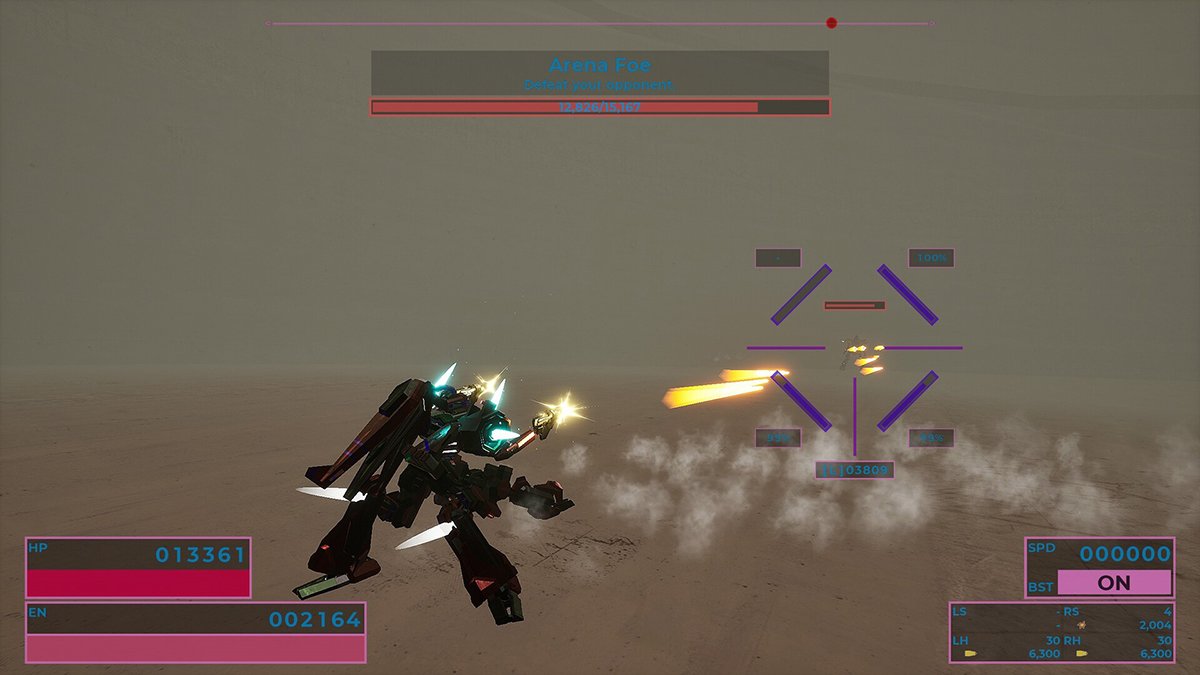
1. Pick your difficulty and extraction setting on purpose
The difficulty names changed right after launch, so older videos might confuse you. You now get Relaxed and Standard, plus harder RIOT versions of each.
Relaxed doesn’t have respawning enemies, and the difficulty scales as you complete objectives. It’s a good place to learn the controls.
Standard is the full experience. Plenty of players say the game feels too soft until you move up to it.
The bigger decision happens when you make your profile. That’s where you choose whether to turn on extraction mechanics, which means you lose your loot if you die before getting out.
Here’s the catch. Right now you can only set extraction at profile creation, and there’s no toggle for it later.
If you’ve never played an extraction game, leave it off for your first profile. Learn to drive before you start betting the car.
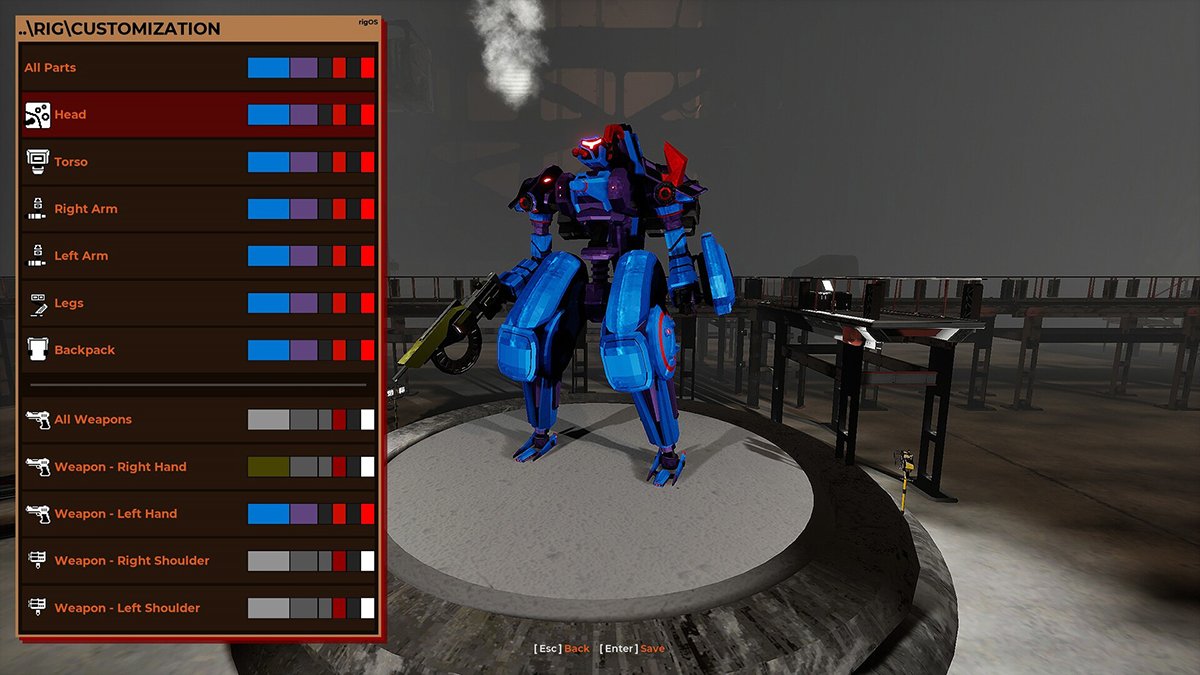
2. Learn the objective loop
Every level runs on the same basic rhythm. You finish three minor objectives (orange), which unlocks one major objective (red).
That cycle repeats up to three times per level. Once you see it, the game stops feeling like random chaos.
Now, the question everybody asks.
Where’s the boss?
Every map has its own unique final boss, but it only shows up if your third major objective lands in a spot where it can spawn. That happens roughly a third of the time.
So if you’ve cleared a map three times without seeing a boss, nothing is broken. You just got unlucky with the spawn.
3. Weight decides everything
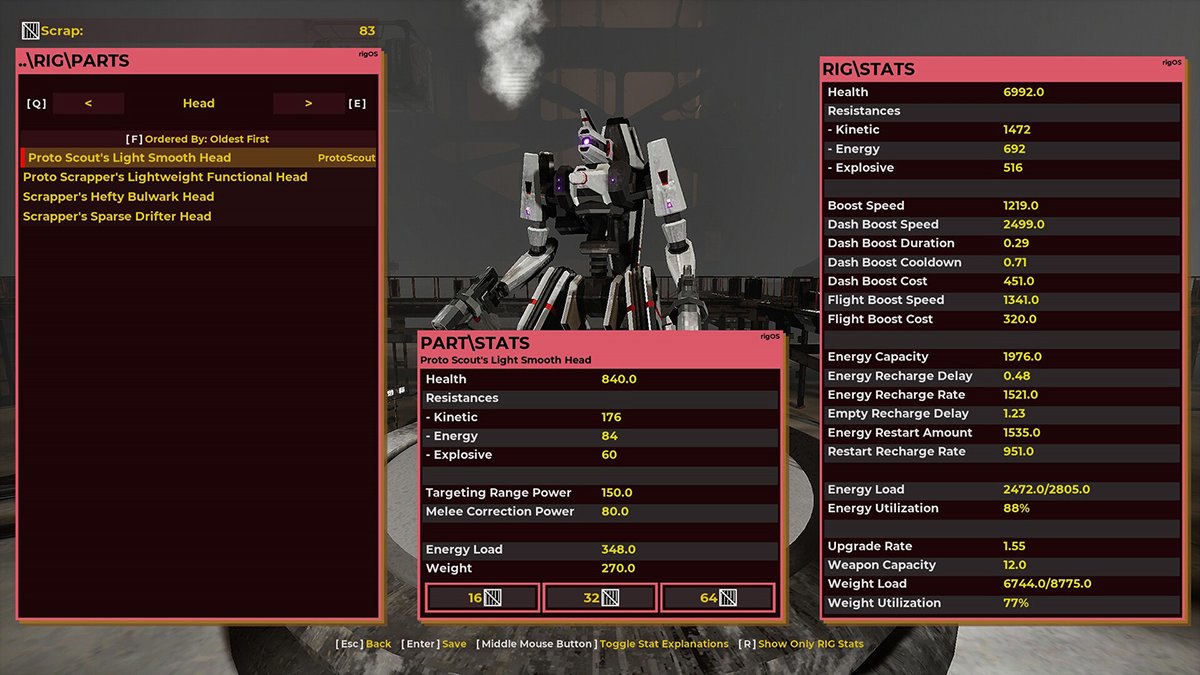
This is the most important thing to understand about building a RIG. Light parts make you fast and mobile. Heavy parts make you a walking tank.
Enemies hit hard in this game, and light builds can go down in just a few hits. Heavy builds survive longer but move slower and make boosting more expensive.
Every set also has a Load Limit, and you want to stay under it. A car with a trunk full of bricks isn’t winning any races.
For your first builds, aim for the middle. A medium RIG that can both move and take a hit will carry you further than an extreme build.

4. Get good at boosting and wall kicks
Movement is where RIG Riot really gets fun. Turbo boost eats energy, and weight affects how much it costs.
Don’t burn your whole energy bar crossing empty ground. Save some for dodging, because that’s what keeps you alive.
Wall kicks are a big part of moving around, and they get stronger with the Dash Power stat. Bounce off walls instead of stopping and turning.
The downward dash is also a lot stronger than it looks. Use it to drop out of the air fast when something big is lining up a shot.
And here’s the move a lot of experienced players swear by. A high-thrust build that circle-strafes enemies is one of the safest ways to fight in the game right now.
5. There’s no stagger, so stop playing it like Armored Core 6
This one trips up a ton of AC6 players.
RIG Riot has no stagger system, and that’s on purpose. The developer didn’t want the combat to turn into fishing for staggers.
So there’s no bar to fill and no big punish window. You just wear enemies down with damage while staying out of their line of fire.
Treat every fight as a damage race you win by not getting hit. The pacing sits somewhere between the older Armored Core games and the newer ones, so you have to keep moving.
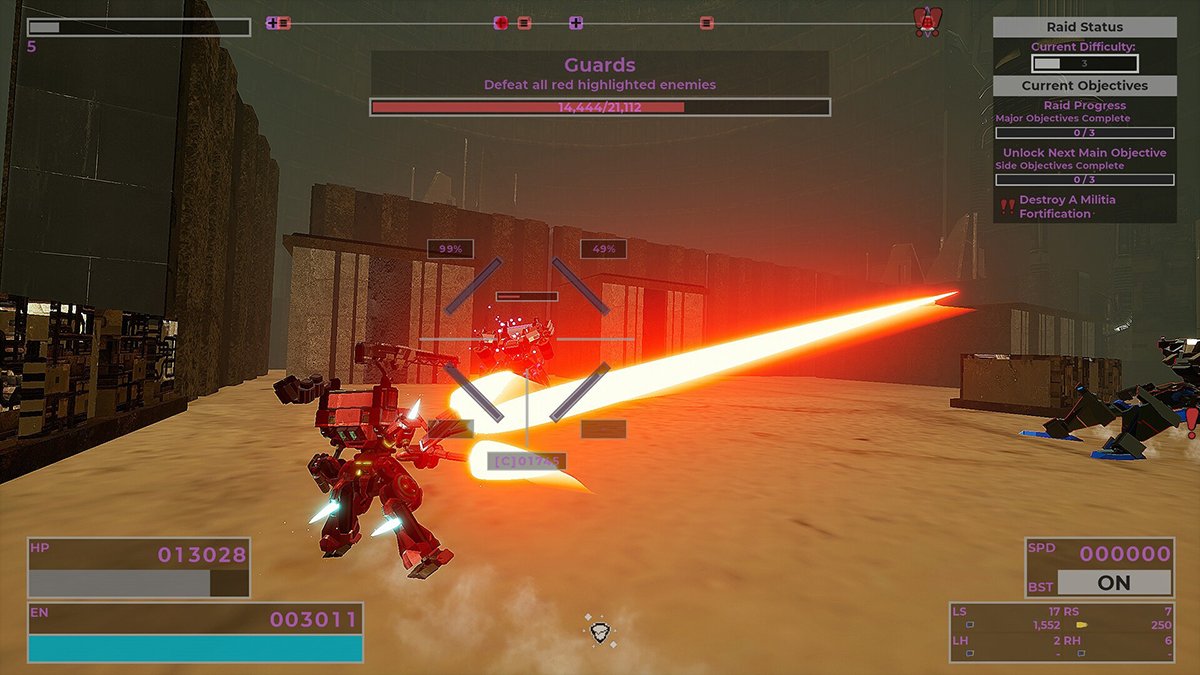
6. Plan your weapons and Volatile Mods around one idea
During a raid you level up, and each level gives you a choice of Weapons and Volatile Mods. This is how your build comes together mid-run.
The mistake new players make is grabbing whatever looks shiny. You end up with a sniper rifle, a shotgun, and a laser blade that don’t work together at all.
Pick a lane early and stick with it. Long-range sniping, missile barrages, automatic weapons, or close-range shotguns and blades.
Quick warning on melee. Ranged builds are generally stronger right now, and the community consensus is that close-range play feels weaker.
If you do go melee, check your settings for the melee auto-lunge toggle, because it changes how blades feel a lot.
Volatile Mods add status effects and other bonuses. Some of the descriptions are vague about the exact numbers, so you’ll have to test a few to see what they really do.
The Nanite effects come up a lot as some of the strongest in the game. If you see them, take a serious look.
7. Don’t throw out your starter parts
You’re going to get a ton of loot. Most of it won’t matter much.
The stat differences between parts are often pretty small, so a shiny new drop isn’t automatically an upgrade.
A lot of players say the starting Scout head and TAS parts stay competitive deep into the game, especially for missile and long-range builds.
Parts come from sets like Scout, Knight, Assassin, and Annelid, and each leans toward a different style.
Part mods drop separately from the parts themselves, and their icons show their rarity. Look at those before you scrap anything.
Speaking of which, scrap the duplicates you won’t use. Scrapping parts gives you Scrap, and there’s no reason to hoard junk.
Back to the garage. When you tune a project car, you change one thing at a time so you know what actually helped.
Swap one part between runs, not five. Otherwise you’ll never figure out why your RIG suddenly feels worse.
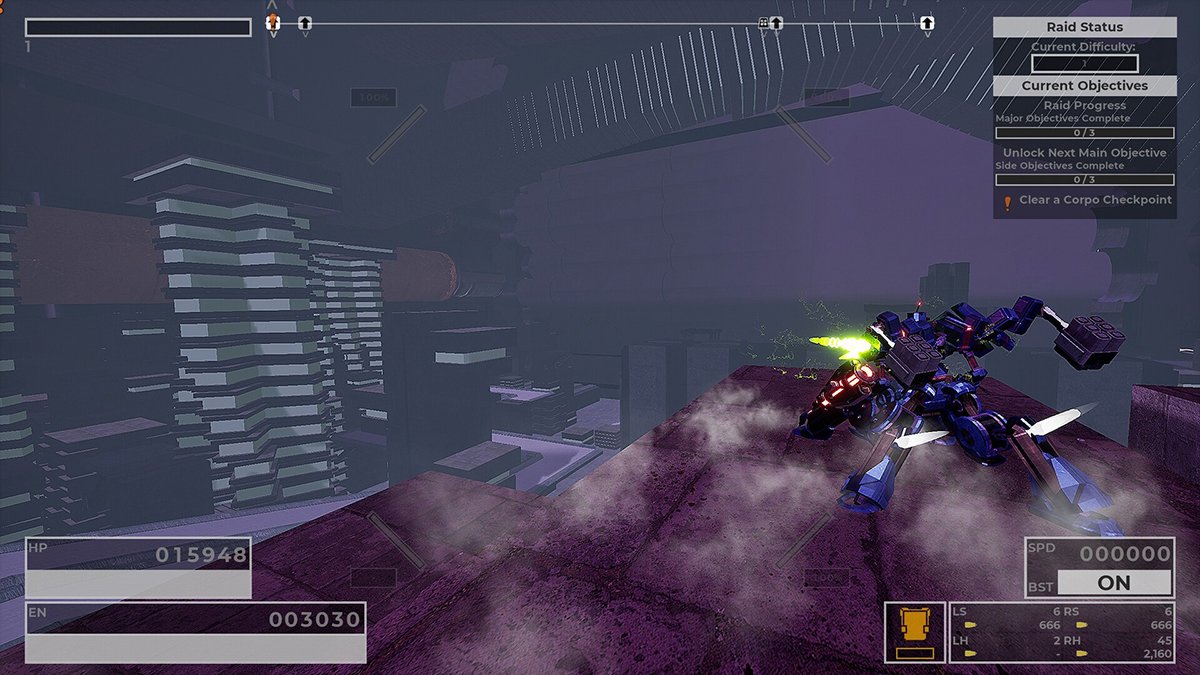
8. Losing a run still pays off
Here’s the good news. Dying doesn’t wipe your progress.
Even failed raids send parts back to your garage, so a bad run still gives you something to play with. The only exception is if you turned on extraction, where dying costs you what you were carrying.
There’s also some built-in forgiveness. If you’re near full health, a hit that would kill you leaves you alive with a sliver of HP instead. That protection has a cooldown, though. Don’t count on it twice in a row.
Every wreck is a trip to the parts store. Go into each run expecting to learn something, not to win.
9. Set up your controls before you blame the game
There’s a hard lock-on option if the default targeting feels loose. Some players find it sticks to enemies behind terrain, so try both and see what works for you.
You get full key rebinding, and you’ll probably want it. The default weapon-hand layout doesn’t match what a lot of PC players are used to.
You can also save weapon loadouts and color palettes. Do that once you find a build you like so you’re not rebuilding it from memory.
Ten minutes in the settings menu can save you hours of frustration.
10. Where to go once you’re comfortable
Once you’ve got a few runs in, there’s a lot more to dig into.
The Arena lets you fight enemy RIGs across different tiers, and it’s a good way to test a build against something that fights back like you do. Flare duels open up as you progress further.
There are also hidden weapons tucked away across the maps. Keep an eye out for spots that look like they’re worth exploring.
If you’re still on the fence, there’s a free demo on Steam with the first stage and six sets of parts to mess around with.
That’s the whole idea behind RIG Riot. You don’t buy a finished race car.
You build one in the garage, run by run, until it finally does what you want it to.
If you like roguelites that reward you for failing, check out our Roguecraft DX beginner tips and our Heroes of Hammerwatch II review. And if you’re hunting for more games like this, we’ve got a list of indie games that are better than most AAA releases.
–
Images in this article are from the RIG Riot page on Steam and used under Fair Use.
Want to start your own blog, a personal website or something for your small business or side hustle? Site Ground is the absolute best web hosting company out there
You Might Also Like...
Mouse Polling Rate 1000 vs 2000 vs 8000 Explained (What It Really Changes, and What to Use)

Mouse polling rate is one of those settings that sounds insanely importan (like flipping from 1000 Hz to 8000 Hz should instantly turn you into an esports god) but in real life it’s more nuanced. If…
How to Force Borderless Fullscreen in PC Games (Every Method That Actually Works)
If you've ever tried to alt-tab out of a PC game and watched your screen freak out for a solid five seconds, you already know why borderless fullscreen mode exists. It's the sweet spot between…
How to Fix Xbox Controller Not Detected on Windows 11
So you've sat down for a gaming session, grabbed your Xbox controller, and… nothing. Windows 11 acts like it doesn't exist. No vibration, no light, no input. Don't worry, you're not alone, and this…
Japanese Rural Life Adventure: Beginner Tips You Need to Know

Japanese Rural Life Adventure has finally made the jump from Apple Arcade to Steam, and if you're a fan of cozy farming sims like Stardew Valley or Harvest Moon, this one absolutely deserves a spot…
Under the Island Tips: The Ultimate Beginner’s Guide to Seashell Island
If you're just stepping onto Seashell Island for the first time, you're in for a treat. Under the Island is a 2D top-down action-adventure that wears its classic Zelda inspiration proudly, mixing…
Retrace the Light Tips: A Beginner’s Guide With Puzzle, Combat, and Exploration Tricks

If you’re looking for Retrace the Light tips or a quick beginner’s guide to Retrace the Light, the biggest thing to know is this: the game is built around a mindset shift. It’s not just “solve…
18 Indie Games that are Better than Most AAA Major Releases
Last updated December 31, 2025. There's been a massive explosion of amazing indie games in recent years. Having an alternative to the massive AAA games is always a good thing and many of these indie…
All Unicorn Overlord Characters: Recruitment Guide, Builds, and Missables
This master post rounds up every recruitable character in Unicorn Overlord, with an alphabetical list linked to a detailed guide for each character. You’ll also find practical tips on recruiting,…
The Top 10 Nintendo 64 Games You Need to Play
The Nintendo 64 launched after the Super Nintendo in 1996 and was Nintendo's first console with fully 3D 64-bit graphics. It's one of the most famous and well-recognized systems in videogame history,…
Golden Sun Djinn Guide and Djinn Location Guide
The Djinn system in the Game Boy Advance classic, Golden Sun, introduces a novel and intricate layer to the traditional RPG formula, setting it apart from its contemporaries. This system not only…
The Top 10 Super Nintendo Games You Still Need to Play
The Super Nintendo Entertainment System (SNES) is a legendary video game console that holds a special place in the hearts of gamers around the world. Released by Nintendo in 1990 (in Japan) and 1991…