
I went into Ledgerbound expecting a joke. The premise is an insurance adjuster who has to leave her desk to go fight an ancient evil, and I assumed that was the whole gag.
What I got instead was a tactics game with real teeth and a cast I got weirdly attached to. It surprised me in the best way.
It is also not great at explaining itself. Here are the things I wish someone had told me before my first battle.

What Ledgerbound actually is
Ledgerbound is a grid-based tactical RPG stitched together with a relationship sim. You fight turn-based battles on a map, then spend downtime between them talking to your party.
If you have played Fire Emblem, the combat will feel familiar right away. The downtime is closer to Persona, where your time is limited and you choose who gets it.
It came out on August 13, 2026 for Windows and macOS, and runs about 20 to 40 hours depending on how much optional content you poke at. The corporate satire is genuinely funny, but the systems underneath it are serious.
Learn the element triangle before anything else
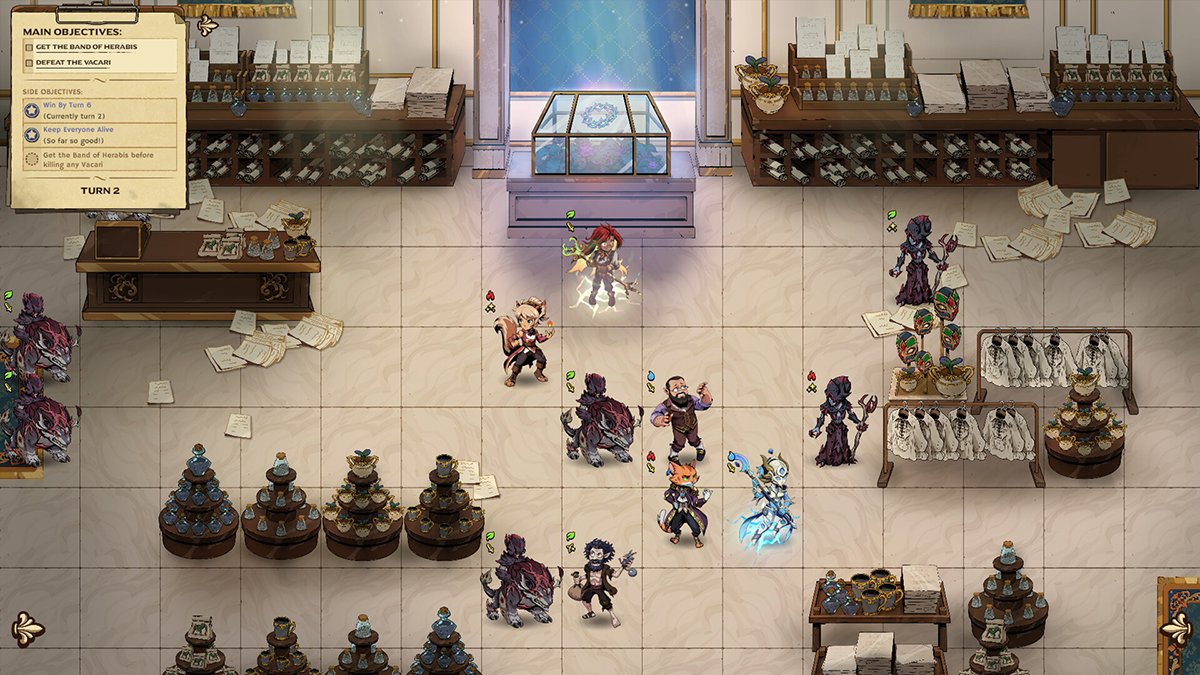
Every character and enemy is aligned to fire, water, or earth. The rule is simple: water beats fire, fire beats earth, and earth beats water.
This is not a small bonus you can ignore. Matching your attacker against the right element is often the difference between a kill and a wasted turn.
The maps care too. Standing on a tile that matches your element gives you a boost, and standing on an opposing one works against you.
So before you move anyone, look at the ground. I lost my first real fight because I was reading the enemies and not the floor.

Attacks get countered, so check range first
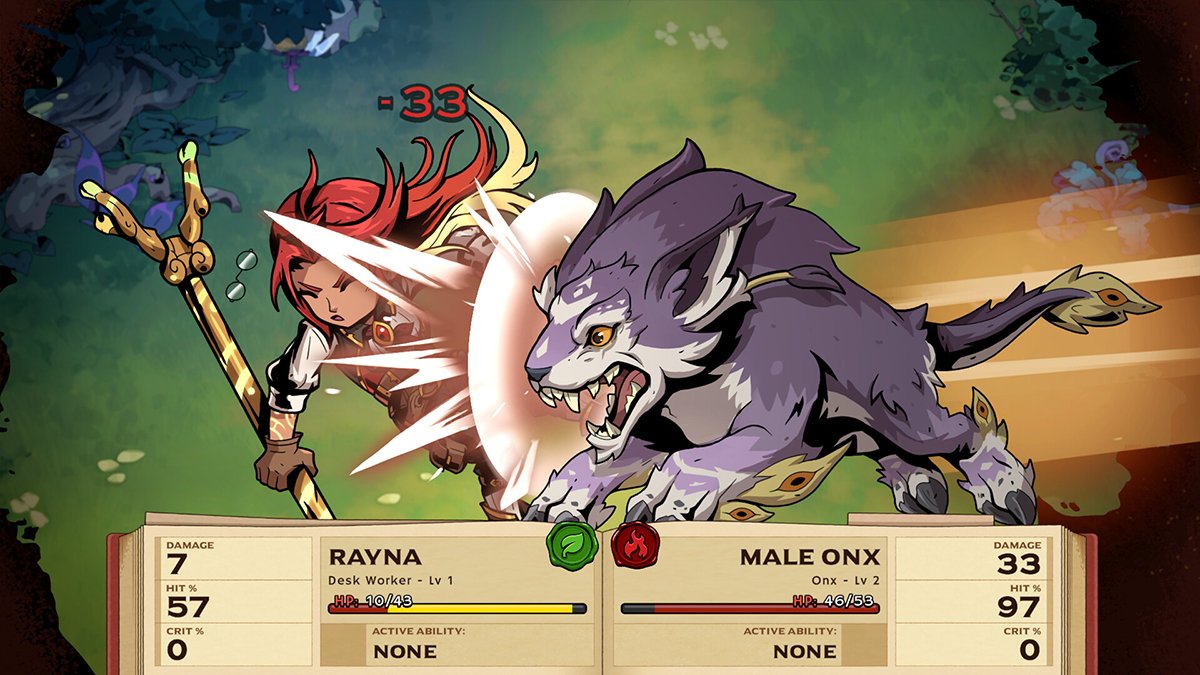
If you attack someone and they survive while you are still in range, they hit you back immediately. Enemies do the same to you on their turn.
That one rule changes how you play. A chip-damage attack that leaves an enemy at a sliver of health is often worse than not attacking at all.
Get in the habit of checking enemy movement and attack ranges before you commit a unit. Ledgerbound shows you this information, but it does not nag you into looking.
Ranged characters are the obvious answer here, since hitting from outside counter range costs you nothing.
Everyone deploys, so everyone needs to swing
There is no bench. Your whole party goes into every battle, which means you never have to agonize over who to bring.
The catch is how experience works. Characters only gain it by attacking or using abilities, so anyone you forget about quietly falls behind the rest of the group.
Once a character is underleveled, they get harder to use, and then you use them even less. That spiral is the main way new players end up stuck.
Feed the easy kills to whoever is lagging. It costs you nothing and saves you a headache six battles from now.
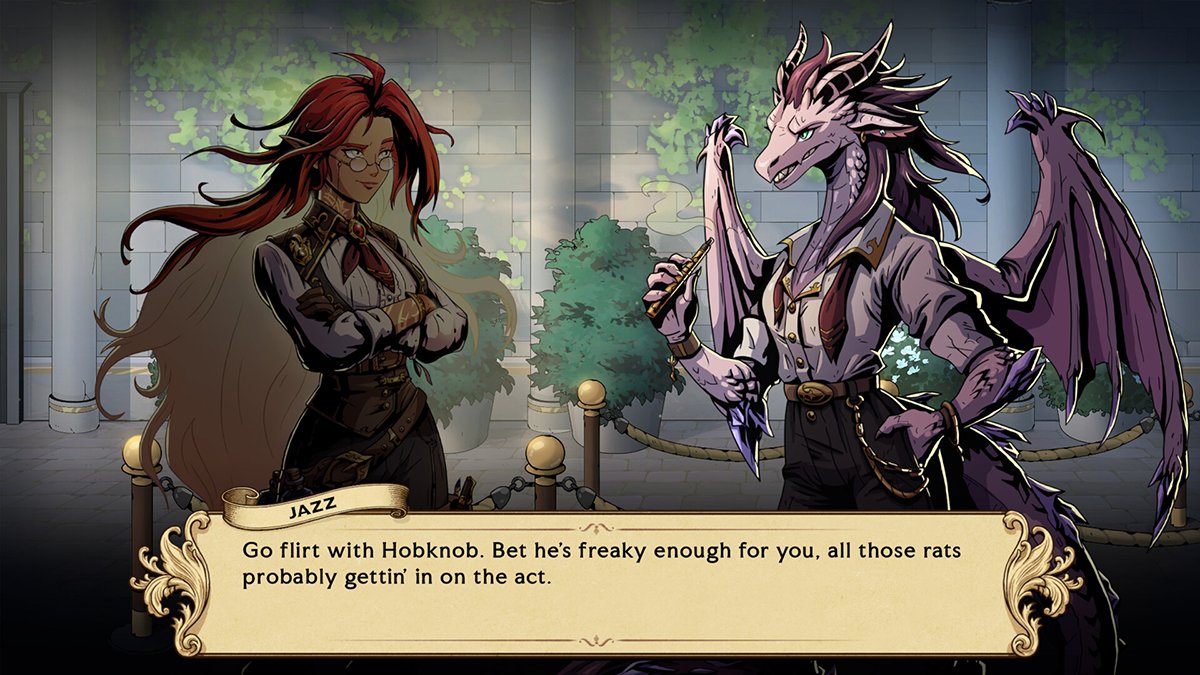
Rayna’s spoons are a real resource
Rayna has a spoons meter, which is the game’s way of tracking her mental energy. Spend too much and she hits burnout, which you do not want.
Conversations, bonding, and general downtime activity all draw from it. The game is making a point about work, and it is making that point through a mechanic you have to manage.
You are not helpless about it. HR-mandated training and battle retries help offset the drain, and they keep the Shareholders happy on top of that.
Think of spoons as your budget for being a person, not a bar that refills on its own.
Resterlude time is the currency that matters
Between battles you get a resterlude, which is where the game’s other half lives. You chat with party members, swap equipment, and replay old fights.
All of that comes out of the same limited pool. Rearranging everyone’s gear is not free, and neither is a nice long conversation.
My advice is to decide what you want out of a resterlude before you open a single menu. Otherwise you will burn half of it on inventory fiddling and wonder where it went.
Use the difficulty slider without guilt
There are three difficulty levels, and you can change them before and after battles. That flexibility is unusual for a tactics game and you should take advantage of it.
If you lose a fight, you can retry it at a lower difficulty for a cost in bonding time. That is a real cost, but it is a much smaller one than getting walled for an hour.
Nobody is grading you on this. If a map is not clicking, drop it a notch, learn what the enemy is doing, and move on with your story.
Swag and liabilities, sorted out
Equipment comes in two flavors and the names are doing a bit. Swag is company merch that fills four slots per character and gives straightforward attribute bonuses.
You unlock swag by earning stars in battle, so it rewards playing well rather than grinding. Liabilities are the interesting ones.
A liability grants a new active ability or a passive perk, usually with some catch attached. Some of them are worth the downside and some absolutely are not.
Early on, keep liabilities on the characters you already understand. Stacking a strange drawback onto someone you are still figuring out just muddies the picture.
Save the optional objectives for replays
Most battles come with optional side objectives alongside the main one. Finishing a fight in a set number of turns, taking no casualties, or getting a character to a specific spot are all typical.
They feed into rewards, so they are worth doing eventually. Chasing them on a first attempt is a good way to lose a battle you would otherwise have won comfortably.
Every fight is replayable. Treat your first run at a map as reconnaissance, then come back for the extras once you know the layout.
There is only one save file
Ledgerbound autosaves aggressively and keeps one file per playthrough, so there is no reloading to undo a choice.
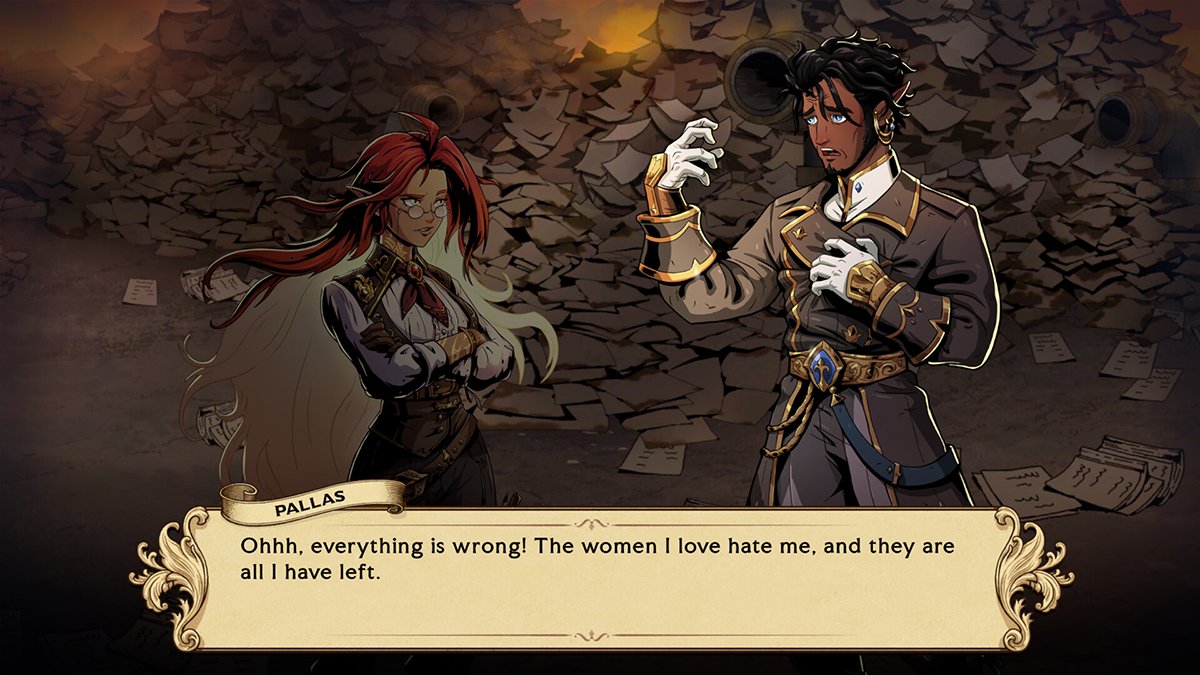
Dialogue decisions stick. Some of them close off scenes you will never see on that run.
I am not saying agonize over every line, because the game is more forgiving than that sounds. I am saying slow down when a conversation feels like it matters, because it probably does.
Relationships reward showing up
The bonding system is more generous than it first appears. Bonds deepen through consistent conversation rather than through picking one magic correct answer.
That takes a lot of pressure off. You are not solving a puzzle, you are just spending time with someone repeatedly.
Given how limited that time is, pick two or three characters you actually like early and stay with them. Spreading yourself across the whole cast leaves every bond shallow.
The romances are fully voiced and better written than the premise suggests, so it is worth committing to someone.
Ledgerbound took me about four battles to click with. Before that I was fighting the systems, and after that I was making plans in my head while I did the dishes.
It is a game about a woman with a terrible job finding people worth caring about, told through a tactics engine that respects your brain. If you go in expecting only the joke, you will be pleasantly wrong.
Play it badly at first. That is what the difficulty slider and the replays are there for.
–
Images in this article are from the Ledgerbound page on Steam and used under Fair Use.
Want to start your own blog, a personal website or something for your small business or side hustle? Site Ground is the absolute best web hosting company out there
You Might Also Like...
Mouse Polling Rate 1000 vs 2000 vs 8000 Explained (What It Really Changes, and What to Use)

Mouse polling rate is one of those settings that sounds insanely importan (like flipping from 1000 Hz to 8000 Hz should instantly turn you into an esports god) but in real life it’s more nuanced. If…
How to Force Borderless Fullscreen in PC Games (Every Method That Actually Works)
If you've ever tried to alt-tab out of a PC game and watched your screen freak out for a solid five seconds, you already know why borderless fullscreen mode exists. It's the sweet spot between…
How to Fix Xbox Controller Not Detected on Windows 11
So you've sat down for a gaming session, grabbed your Xbox controller, and… nothing. Windows 11 acts like it doesn't exist. No vibration, no light, no input. Don't worry, you're not alone, and this…
Japanese Rural Life Adventure: Beginner Tips You Need to Know

Japanese Rural Life Adventure has finally made the jump from Apple Arcade to Steam, and if you're a fan of cozy farming sims like Stardew Valley or Harvest Moon, this one absolutely deserves a spot…
Under the Island Tips: The Ultimate Beginner’s Guide to Seashell Island
If you're just stepping onto Seashell Island for the first time, you're in for a treat. Under the Island is a 2D top-down action-adventure that wears its classic Zelda inspiration proudly, mixing…
Retrace the Light Tips: A Beginner’s Guide With Puzzle, Combat, and Exploration Tricks

If you’re looking for Retrace the Light tips or a quick beginner’s guide to Retrace the Light, the biggest thing to know is this: the game is built around a mindset shift. It’s not just “solve…
18 Indie Games that are Better than Most AAA Major Releases
Last updated December 31, 2025. There's been a massive explosion of amazing indie games in recent years. Having an alternative to the massive AAA games is always a good thing and many of these indie…
All Unicorn Overlord Characters: Recruitment Guide, Builds, and Missables
This master post rounds up every recruitable character in Unicorn Overlord, with an alphabetical list linked to a detailed guide for each character. You’ll also find practical tips on recruiting,…
The Top 10 Nintendo 64 Games You Need to Play
The Nintendo 64 launched after the Super Nintendo in 1996 and was Nintendo's first console with fully 3D 64-bit graphics. It's one of the most famous and well-recognized systems in videogame history,…
Golden Sun Djinn Guide and Djinn Location Guide
The Djinn system in the Game Boy Advance classic, Golden Sun, introduces a novel and intricate layer to the traditional RPG formula, setting it apart from its contemporaries. This system not only…
The Top 10 Super Nintendo Games You Still Need to Play
The Super Nintendo Entertainment System (SNES) is a legendary video game console that holds a special place in the hearts of gamers around the world. Released by Nintendo in 1990 (in Japan) and 1991…